
Why Houston Black Clay Soil Matters for Your Katy Concrete Project
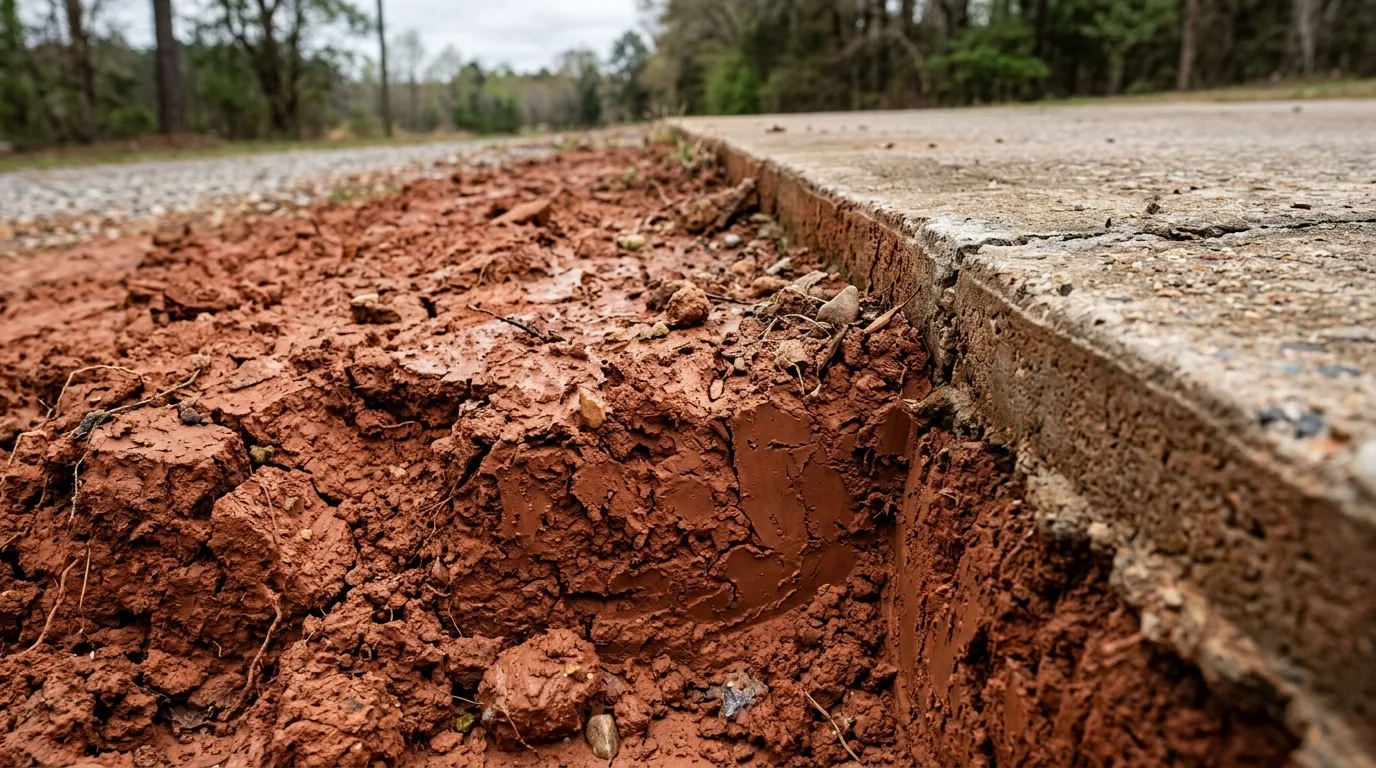
Every experienced concrete contractor in the Katy area knows that Fort Bend County’s soil is the variable that determines whether a driveway lasts 10 years or 40. But most homeowners have never heard the term “Houston Black” or understand what makes this soil so challenging for concrete construction. In this post, we explain what Houston Black clay is, how it damages concrete, and what proper construction techniques do to counteract it.
Concrete Built for Katy's Clay Soil
Free estimate with full subbase specification for your property. Call (888) 376-0955.
What Is Houston Black Clay?
Houston Black is the official state soil of Texas — a designation given to the soil series most characteristic of the state and most widely encountered across its landscape. It is a very deep, moderately well-drained, very slowly permeable clay formed from calcareous clay and marl deposits. The technical description matters for concrete work because of two specific properties: its plasticity index and its cation exchange capacity.
The Plasticity Index (PI) of Houston Black typically ranges from 35 to 50, with some locations exceeding 44. Plasticity Index measures a soil’s range of water content between two critical states — when it behaves as a liquid versus when it becomes too stiff to be molded. A high PI means the soil changes volume significantly between wet and dry states. For concrete, this translates directly to sub-slab movement: the soil expands upward against the slab when saturated and contracts and pulls away when dry.
This soil underlies most of Katy and the surrounding Fort Bend County area. When homeowners in Elyson notice cracks in driveways just a few years after installation, or when Firethorne residents see patio edges lifting along one side, the Houston Black clay beneath their slabs is almost always the driving cause.
How Soil Shrink-Swell Damages Concrete
Understanding the mechanism helps explain why certain construction choices matter. The soil beneath a concrete slab is not static — in Katy’s climate with 48–51 inches of annual rainfall, it goes through significant wetting and drying cycles multiple times per year.
During wet periods (May, October are the wettest months): Clay expands as it absorbs water. In Houston Black clay, this expansion can produce upward soil movement — heave — of 1–3 inches in locations with particularly active soil. When this expansion is not uniform across the entire slab footprint (which it rarely is, because drainage creates moisture gradients), different sections of the slab experience different upward forces. Sections over saturated clay lift slightly; sections over better-drained areas do not. The result is differential movement within the slab — and concrete, being rigid, cracks under differential stress.
During dry periods: As the clay dries and contracts, it shrinks away from the underside of the slab. Where the slab was previously supported by the swelled clay, it now hangs over a slight void. Subsequent traffic loads apply bending stress to slab sections that no longer have continuous support below them. Combined with the expansion forces from the wet season, this repeated cycle produces the characteristic cracking patterns seen in Katy: cracks running diagonally across corners, parallel cracks in the middle of driveways, and edge sections that lift then drop.
Is Your Katy Concrete Built for Clay Soil?
We assess your soil conditions and build to the right specifications. Call (888) 376-0955.
What Proper Concrete Construction Does to Address It
Understanding the mechanism also explains why each component of proper Katy concrete construction matters:
Compacted gravel subbase (4–6 inches): Crushed limestone gravel is placed and compacted beneath the concrete slab before pouring. The gravel drains water rapidly, reducing the saturation cycles in the clay immediately beneath the slab. It also provides a more stable, consistent support layer that buffers the concrete from the clay’s movement. Slabs poured directly on compacted clay — without gravel base — experience the full magnitude of soil movement directly.
Rebar reinforcement: The rebar grid (typically #4 rebar on 24-inch centers for residential Katy driveways) holds the concrete slab together across cracks. When soil movement produces cracking — and it will, eventually, even in properly built slabs — rebar prevents the sections from separating and settling differentially. An unreinforced slab that cracks over Fort Bend County clay can quickly develop into distinct, uneven sections that create trip hazards and accelerate further deterioration.
Control joints: Placed at calculated intervals across the slab, control joints are intentional weak points where stress relieves as the concrete expands and contracts with temperature changes and moisture. Properly placed control joints direct cracking to invisible lines, keeping the cosmetically visible surface intact while the slab manages the stresses it must manage.
Drainage design: Keeping the soil beneath the slab as consistently moist as possible — and avoiding alternating extremes of saturation and desiccation — reduces the magnitude of shrink-swell movement. This means designing driveways and patios to drain water quickly away from the perimeter, preventing pooling adjacent to the slab edges where water infiltrates most readily.
Lime stabilization (for commercial and foundation work): For high-stakes applications like foundation slabs and commercial parking lots, lime stabilization chemically modifies the clay subgrade, reducing its plasticity and eliminating most of the shrink-swell behavior. This adds cost but dramatically improves performance on particularly active clay.
What This Means for Different Project Types
Driveways: The subbase and rebar specification are the critical variables. A Katy driveway without adequate gravel base and rebar is a 10-year project. With proper preparation, the same driveway is a 40-year project. The cost difference at installation is roughly $1–$2/sq ft — the long-term performance difference is 30 years.
Patios: Drainage design at the patio perimeter is particularly important because patios are usually at grade and adjacent to landscape plantings that receive irrigation water. Chronic moisture at patio edges accelerates the soil movement cycle specifically at the most vulnerable sections — corners and edges.
Foundations: Foundation engineering for Fort Bend County soil is a specialized discipline. Residential slab foundations in Katy are typically engineered with deeper grade beams, heavier rebar density, and in some cases post-tension cables or lime stabilization beneath the slab. Properties in areas of particularly active Houston Black clay may also require engineered fill or moisture management systems to prevent differential settlement.
Frequently Asked Questions
Can I just seal my concrete to protect it from the soil?
Sealing protects the surface from UV degradation and reduces moisture infiltration through the slab itself — but it doesn’t address the soil conditions beneath the slab. Sealing is important maintenance for any Katy concrete surface, but it is not a substitute for proper subbase preparation. The soil movement that cracks concrete slabs comes from below, not from above.
Does the clay soil affect concrete differently in different Katy neighborhoods?
Yes — soil conditions vary across the Katy area. Locations closer to the natural drainage corridors (Barker Reservoir area, Bear Creek) have higher water table conditions that can increase heave potential during wet periods. Areas on higher ground with better natural drainage experience less extreme shrink-swell cycles. We assess site-specific conditions during the estimate process rather than applying a uniform specification to every property.
Is there anything I can do to protect existing concrete from soil damage?
Maintaining consistent soil moisture near your concrete is the most practical protective measure. Keep irrigation systems directed away from driveway and patio perimeters. Repair downspout connections that direct concentrated water flow toward concrete edges. Fill cracks promptly before they allow water to penetrate to the subbase. Annual inspection and early intervention is far less expensive than replacement.
Related posts:
- Why Katy Driveways Crack — And How to Prevent It
- Concrete Foundation Options for New Construction in Katy
- Best Time of Year for Concrete Work in Katy, TX
Concrete Built Correctly for Fort Bend County Clay
Katy Concrete Contractor specifies every pour for the soil conditions under your property. Call (888) 376-0955.