
Concrete Foundation Options for New Construction in Katy, TX
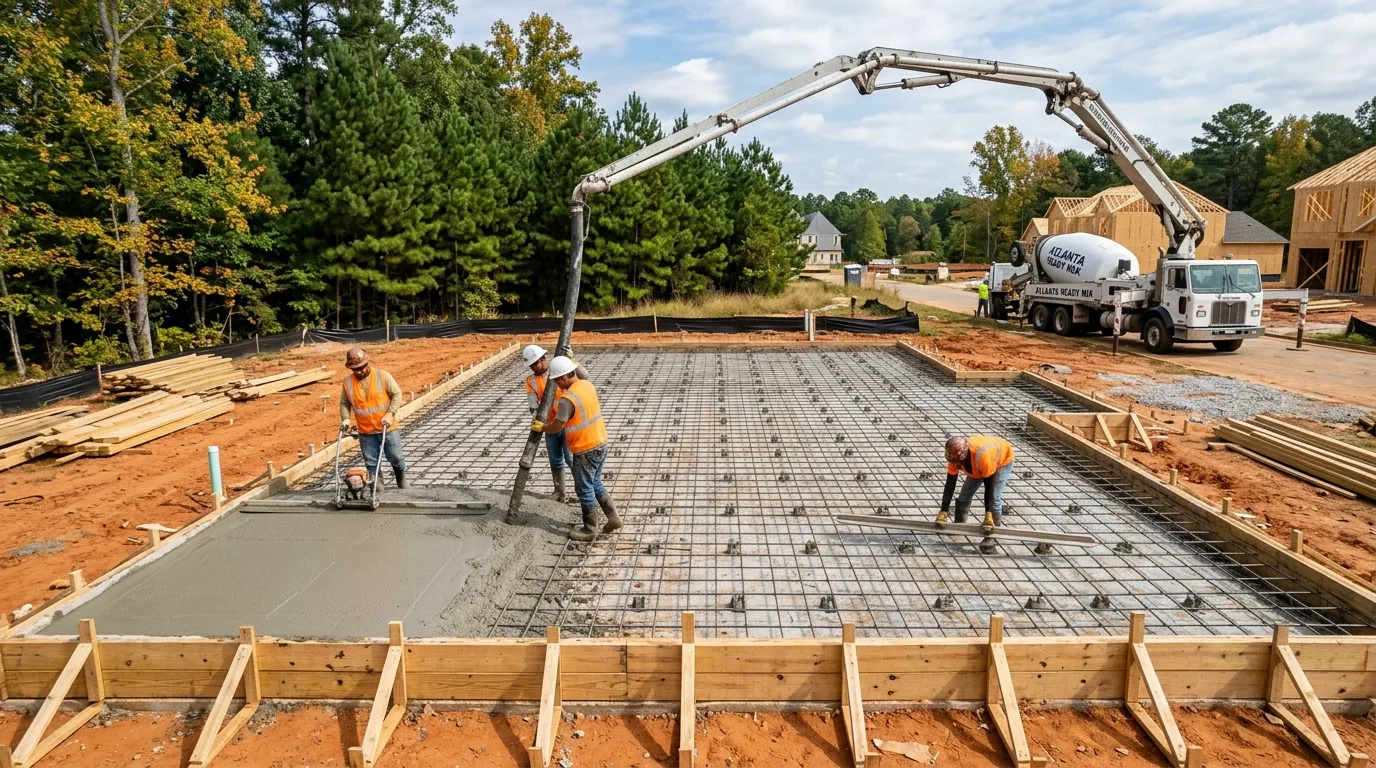
New construction in Katy is happening at a remarkable pace — from master-planned communities like Elyson and Cane Island adding thousands of homes annually to the explosive commercial development along the Grand Parkway corridor. Every one of those buildings starts with a concrete foundation, and in Fort Bend County, the foundation choice and specification determines whether that structure remains stable for decades or develops the differential settlement issues that plague improperly engineered foundations on Houston Black clay soil. In this guide, we cover the concrete foundation options used in Katy new construction, what each costs, and what the local soil conditions require.
Foundation Estimate for Your Katy Construction Project
Engineering coordination included. Free estimate — call (888) 376-0955.
Why Foundation Engineering Is Non-Negotiable in Katy
Most residential construction in the United States is built on soil that doesn’t move much. Katy’s Houston Black clay soil moves — measurably, repeatedly, and significantly. With a Plasticity Index up to 44, this clay swells when it absorbs Katy’s 48–51 inches of annual rainfall and shrinks when the soil dries out. The resulting vertical movement — sometimes an inch or more in locations with particularly active clay — is the mechanism behind the foundation distress that affects thousands of Katy-area homes.
The foundation options used in Katy new construction are specifically engineered to manage this soil behavior. The choice between them depends on the structure type, the specific lot’s soil report, and the engineer’s analysis of the expected soil movement at that location. A foundation that is “standard” in Fort Bend County would be over-engineered in most of the country — because the standard reflects the real conditions beneath the property.
For every Katy new construction foundation, Texas law requires that drawings be reviewed and stamped by a licensed Professional Engineer (PE) or Structural Engineer (SE). This is not a formality — it’s the step that ensures the foundation is designed for the actual soil conditions at the specific site.
Option 1: Conventional Slab-on-Grade with Grade Beams
The most common residential foundation in Katy and greater Houston is the slab-on-grade with thickened perimeter and interior grade beams. In this system, a concrete slab is poured monolithically with thickened beam sections — both around the perimeter and at interior lines — that penetrate deeper into the soil than the slab itself.
How it works for Katy’s soil: The grade beams anchor the foundation at depth, below the most active zone of soil movement. When the near-surface clay shrinks or swells, the beams resist being displaced while the slab section between them is supported by the beams. The deeper the beams, the less the foundation moves with surface soil changes.
Typical Katy specification:
- Slab thickness: 4 inches (living areas), 5 inches (garage)
- Perimeter beam depth: 18–24 inches minimum
- Interior beam depth: 12–18 inches
- Rebar: #4 rebar at 18-inch centers in slab, #4 or #5 rebar in beams
- Concrete: 3,500–4,000 PSI
Cost: $5–$9/sq ft installed. A 2,000 sq ft slab runs $10,000–$18,000.
Best for: Standard residential new construction on moderately active soil. The most common choice in new Katy communities like Elyson and Cane Island.
Option 2: Post-Tensioned Slab
Post-tensioned (PT) slabs use high-strength steel cables (tendons) placed within the slab before the pour. After the concrete cures, the tendons are tensioned using hydraulic jacks, placing the entire slab under compression. A slab under compression is far more resistant to the bending and cracking forces that expansive clay soil produces than an unreinforced or conventionally reinforced slab.
How it works for Katy’s soil: The compression introduced by post-tensioning counteracts the tensile forces that soil movement places on the slab. When the clay beneath one section of the slab moves up or down relative to adjacent sections, the PT slab resists the differential bending that would crack a conventional slab. PT slabs are the standard choice for new home construction in the greater Houston area for this reason.
Typical Katy specification:
- Slab thickness: 4–5 inches
- Post-tension tendons: 70 ksi cables at 4–6 foot spacing
- Perimeter beam depth: 18–24 inches
- Concrete: 4,000 PSI minimum (required for PT)
- Engineer-stamped design required for all PT systems
Cost: $6–$10/sq ft installed. Slightly higher than conventional rebar systems due to tendon materials and stressing labor.
Best for: New residential and commercial construction throughout Fort Bend County. The most common foundation type for new homes built by production builders in Katy. The extra cost over conventional rebar is modest and the performance advantage on Houston clay is significant.
Post-Tension or Conventional Foundation in Katy?
We install both — free estimate with engineering coordination. Call (888) 376-0955.
Option 3: Pier and Beam (Not Common for New Construction)
Pier and beam foundations use concrete piers drilled into stable soil below the active zone, connected by grade beams, with the floor structure built above grade. This system essentially “steps over” the active clay near the surface and bears on deeper, more stable material.
Relevance for Katy new construction: Pier and beam foundations are rarely specified for new residential construction in Katy today — slab systems are preferred for their lower cost and easier maintenance. However, pier and beam systems are sometimes used for commercial construction where the building requires a crawl space for mechanical systems, or in specific locations where the soil profile makes deep piers more economical than an engineered slab.
Cost: Higher than slab systems — pier drilling adds significant cost. Rarely competitive with post-tensioned slabs for standard residential use.
Option 4: Lime-Treated Subgrade + Slab
For particularly active clay locations — common in parts of Fort Bend County where the PI is near the upper end of the Houston Black range — lime stabilization of the subgrade before the slab pour dramatically reduces soil movement. Hydrated lime is mixed into the top 6–12 inches of clay soil, chemically modifying it to reduce plasticity and swell potential.
How it works: Lime reacts chemically with clay minerals to produce calcium silicate hydrates — essentially a low-grade cementitious reaction within the soil. This reduces the PI from 40+ down to 20 or below, dramatically reducing the shrink-swell behavior that drives foundation movement.
Cost: Adds $2–$4/sq ft to the foundation cost. Cost-justified on commercial projects and on residential lots with particularly active soil conditions where the engineer’s soil report indicates elevated heave risk.
Best for: Commercial foundations, lots with soil reports showing PI above 35, and new residential construction in areas with known foundation movement history.
What Your Engineer’s Soil Report Will Tell You
For every new construction project in Katy, a geotechnical soil report (soils boring report) should be obtained before foundation design begins. This report drills 2–4 test borings on the lot, tests the soil at multiple depths, and provides the engineering data the foundation designer needs.
Key information the soil report provides:
- Plasticity Index at the site: Determines how active the soil is and what foundation system is appropriate
- Bearing capacity: Determines the minimum foundation depth and dimensions
- Groundwater depth: Affects drainage design and foundation waterproofing requirements
- Recommended foundation type: The geotechnical engineer recommends the system appropriate for the specific site conditions
This report costs $800–$2,500 for residential projects and is the most important document in the foundation design process. Skipping it — which some cost-cutting builders do — is a false economy that has produced the foundation distress seen in many older Katy subdivisions built before soil testing was standard practice.
Frequently Asked Questions
What type of foundation is standard for new homes in Katy, TX?
Post-tensioned slabs are the standard for new home construction in Katy and the greater Houston area. Production builders in communities like Elyson, Cane Island, and Cinco Ranch use PT slabs as their standard foundation system because they perform significantly better than conventional slab-on-grade on Houston Black clay soil. Custom home builders typically have engineers design a site-specific foundation based on the lot’s soil report.
Do I need a soil test for a new foundation in Katy?
Yes — a geotechnical soil test is strongly recommended and required by most engineers as the basis for foundation design. Texas law requires that foundation drawings be stamped by a licensed engineer, and responsible engineers require a soil report before designing a foundation. The cost of a soil test ($800–$2,500) is trivial relative to the foundation construction cost and the cost of foundation repair if the design is inadequate for the site’s soil conditions.
How much does foundation work cost in Katy, TX?
Standard slab-on-grade with grade beams: $5–$9/sq ft. Post-tensioned slab: $6–$10/sq ft. For a 2,000 sq ft residential slab, the all-in foundation cost runs $10,000–$20,000 depending on system and site conditions. Engineering fees and permit costs are additional. We provide written estimates that include all components after reviewing your project scope and any available soil information.
Related posts:
- Why Houston Black Clay Soil Matters for Your Concrete Project
- Commercial Concrete Contractors in Katy: What Businesses Need
- New Home Construction: Budgeting for Concrete Work in Katy
Foundation Concrete for Your Katy New Build
Engineering coordination, permit management, and expert installation. Call (888) 376-0955.